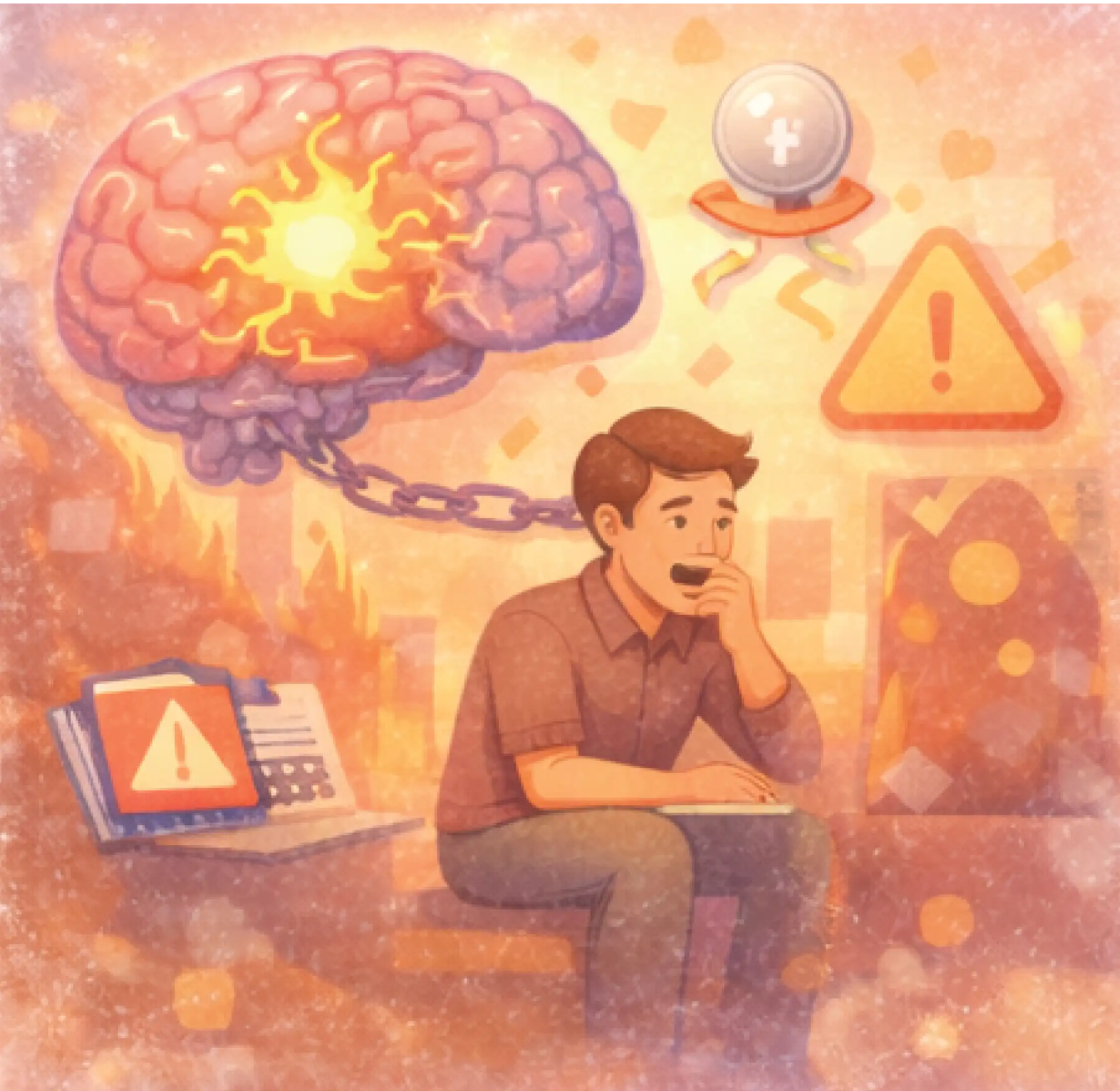

“Why Did I Say That?” — The Moment Your Brain Hit the Panic Button
You’ve had that moment. A message arrives. A tone shifts. A meeting turns. And suddenly you’re saying things you don’t believe, doing things you don’t endorse, feeling like a passenger inside your own head. Five minutes later, logic returns and whispers, Why did I react like that? That isn’t me. It was you. But it was you under alarm. This isn’t weakness or bad character. It’s neurobiology—the brain’s ancient survival machinery overriding your slower, wiser systems. To change the reaction, you first need to understand the machine. Welcome to the amygdala hijack: when your emotional brain sprints, your thinking brain limps, and your behaviour tries to keep up.Meet the Alarm Team: Amygdala, HPA Axis, and the Shortest Shortcut in Your Brain
Think of your brain as a city with two control rooms.- The amygdala is the fire alarm—fast, sensitive, often dramatic. It scans for threat 24/7 and shouts first, explain later.
- The prefrontal cortex (PFC) is city hall—deliberate, nuanced, excellent at long-term planning, terrible at sprinting.
- Low Road (Fast Lane): Thalamus → Amygdala Lightning-fast, imprecise, survival-first. Better to jump at a “snake” that’s a rope than the other way around.
- High Road (Slow Lane): Thalamus → Sensory cortex → Hippocampus (context) → Prefrontal cortex → Amygdala Slower, accurate, meaning-driven. This is where nuance lives.
- Fight: argue, attack, control.
- Flight: leave, avoid, distract.
- Freeze: shut down, go blank, “I don’t know.”
- Fawn: appease, over-agree, abandon self to keep peace.
Why Smart People Melt Down: The Brain’s Bandwidth Problem
Under alarm, blood flow and energy shift away from your PFC to the motor/emotional systems. That’s why you can’t find words, remember facts, or hold perspective mid-conflict. Your brain isn’t broken—it’s prioritising survival over diplomacy. Key effects of an amygdala hijack:- Tunnelled attention: you fixate on the threat cue; everything else blurs.
- All-or-nothing thinking: nuance collapses into always/never, safe/danger.
- Memory distortion: you recall past hurts faster than past repairs.
- Time compression: urgency rises; patience vanishes.
- Body first, thought second: sensations lead, stories follow.
Triggers: Not Just Events—Patterns Your Brain Learned to Fear
A trigger isn’t only a loud noise or a slammed door. It can be:- Sensory cues: a tone of voice, notification sound, certain smells.
- Relational cues: disapproval, silence, being interrupted, being ignored.
- Internal cues: a thought (“I’m failing”), a body sensation (fluttering chest), fatigue.
- Context cues: deadlines, crowded rooms, “We need to talk.”
- Hippocampus: tags context. As stress rises, hippocampal precision drops; everything feels familiar-dangerous.
- Prefrontal cortex: provides reappraisal. Under high stress, its voice is muted.
Freeze and Fawn: The Forgotten Survival Modes
We talk a lot about fight and flight. But in therapy rooms, freeze and fawn are just as common—and often misread.- Freeze looks like “calm,” but it’s shutdown. Blank mind, numb body, polite nodding, later spirals.
- Fawn looks like cooperation, but it’s appeasement. Over-apologising, over-explaining, “it’s fine” while self-betraying.
Adolescent Brains: Supercharged Alarms, Slow Brakes
Teens aren’t dramatic; they’re developing. The reward/emotion circuits mature earlier than the prefrontal brakes. Add social evaluation, sleep debt, and digital stimulation and you get volatility that’s biological, not moral. Translation: a 15-year-old’s “overreaction” is often architecture, not attitude. Guidance beats judgment. Structure beats shame.Digital Life: Micro-Triggers, Macro Fatigue
Phones deliver a steady drip of alarm cues:- Unpredictable rewards (likes, messages) keep the amygdala vigilant.
- Ambiguous texts force negative interpretations (“OK.” = rejection).
- News cycles amplify threat salience.
- Work pings collapse boundaries; your body never exits ready mode.
Five Myths About Emotional Hijacks (and the Science Instead)
Myth 1: “Strong people stay logical.” Reality: Strength is state management, not suppression. Everyone’s PFC dims under enough load. Myth 2: “Just think positive.” Reality: Cognition works after physiology settles. Breath leads thought. Myth 3: “If it’s old, it should be over.” Reality: The amygdala encodes associations, not calendars. Old pain can feel current until reprocessed. Myth 4: “I’m either rational or emotional.” Reality: Best decisions use both—emotion as data, cognition as editor. Myth 5: “If I’m triggered, someone else is to blame.” Reality: Others influence; your brain chooses the path it learned. That path can be rewired.The Three-Stage Reset: Body → Mind → Behaviour
When the alarm is blaring, don’t start with a pep talk. Start with physiology.1) Body: Downshift the Alarm
- Paced breathing (physiological sigh): Inhale gently through nose; brief top-up inhale; long exhale through mouth. Repeat 5–10 times.
- Exhale-weighted breathing: 4 seconds in, 6–8 out. Longer exhales engage the vagal brake.
- Orienting: Turn your neck slowly; scan the room; name 5 blue things. Teach the brain: No predator here.
- Cold water/cold splash: Brief facial cold can dampen sympathetic arousal.
- Grounding: Firm feet, press palms together, name 5–4–3–2–1 (see/feel/hear/smell/taste).
2) Mind: Give the PFC a Job
Once the body eases, bring in language.- Name it to tame it: “I’m feeling threatened and cornered, not actually in danger.”
- Differentiate then/now: “This reminds me of being dismissed, but this is my colleague, not my parent.”
- Zoom out: “What’s the smallest next right move for the next 10 minutes?”
- Reframe: “Their tone might be stress, not hostility. Ask, don’t assume.”
3) Behaviour: Micro-Repair
- Buy time: “I want to respond well. Can we pause for 5 minutes?”
- Ask, don’t mind-read: “When you said X, I felt Y. Did you mean Z?”
- Boundary, not blame: “I’ll continue this after lunch when I can focus.”
Rewiring the Alarm: What Actually Changes the Brain
You can’t bully your amygdala into calm. You can train it.- Exposure with safety (gradual): Practice tiny versions of the trigger while regulated. Public speaking? Start with a 60-second update to a friendly peer.
- Pattern interrupts: If your loop is doomscroll → panic → insomnia, insert a 10-minute audio walk between work and phone.
- Sleep first: Sleep loss amplifies amygdala reactivity and weakens PFC control. Protect it like medicine.
- Exercise as dose: Movement metabolises stress hormones and raises vagal tone.
- Relational regulation: Co-regulation (a calm person, soft voice, eye contact) teaches your nervous system what safety feels like with people, not just alone.
- Therapeutic reprocessing: Counselling (CBT, EMDR, parts work, trauma-informed therapy) helps update the brain’s predictions so present triggers stop borrowing power from past pain.
In the Room: How Counsellors Work With Hijacks
A good counsellor is part scientist, part mirror, part nervous-system mentor. In session they will:- Map your triggers (situations, cues, stories, sensations).
- Identify your dominant survival response (fight/flight/freeze/fawn).
- Teach state skills (breath, grounding, orienting, posture, pacing).
- Challenge survival stories (“If I disagree, I’ll be abandoned”).
- Rehearse micro-behaviours (ask a clarifying question, request a pause, set a 24-hour rule before replying).
- Track outcomes with brief scales (anxiety spikes per week, recovery time after conflict). Progress is visible, not just “felt.”
Leadership & Parenting: Two Places the Alarm Spreads Fast
At work: Leaders under threat micromanage (fight), dodge decisions (flight), go silent (freeze), or over-please stakeholders (fawn). Teams feel it instantly. Practical fixes: clear decision windows, “cool-off then respond” norms, written de-escalation SOPs, and training in curiosity-led questions. At home: Kids borrow the nervous systems around them. A parent who can name their own state (“I’m tense; I need two minutes”) teaches regulation more powerfully than any lecture. For teens, remember their brakes are still building—structure safety, model the reset, praise recovery not perfection.A Pocket Protocol for Your Next Hijack
- Notice: I’m activated (heart, jaw, chest, tunnel vision).
- Breathe: 5 slow cycles with long exhales.
- Orient: head turns, room scan, feet on floor.
- Name: “This is alarm, not truth.”
- Ask: “What’s the smallest next right move?”
- Act small: Pause or ask one clarifying question.
- Review later: What triggered? What worked? What’s the tweak?