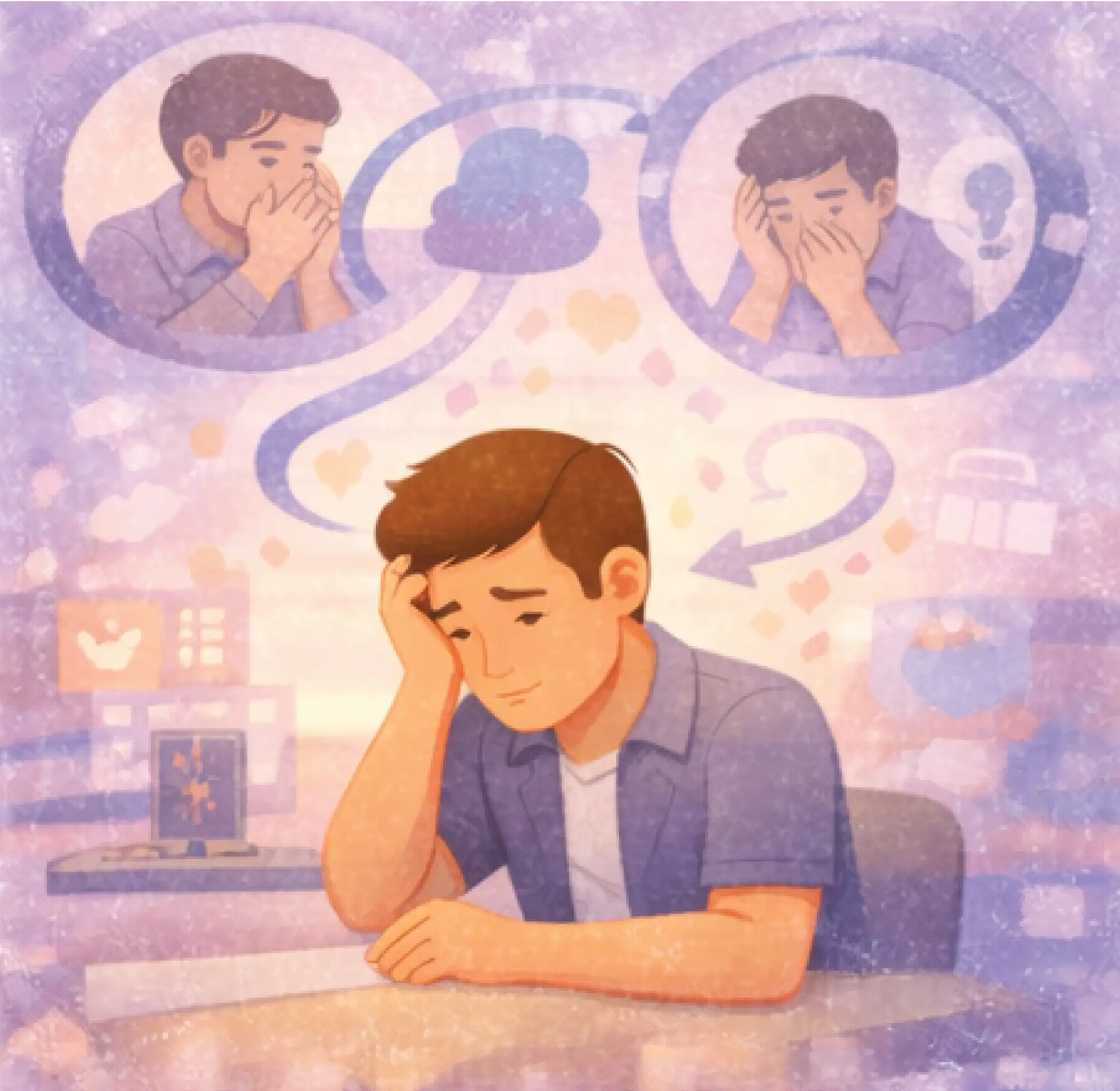

“Why am I rewatching the worst part of my life like it’s a favorite episode?”
You’re brushing your teeth—and suddenly you’re back in that office, hearing the sentence that ended your project. You’re cooking—and a three-year-old betrayal plays in 4K. You try to sleep—and your mind hosts a midnight film festival, showing only the scenes you’d pay to forget. You’re not choosing this replay; it’s choosing you. Here’s the uncomfortable relief: you’re not broken. You’re predictably human. The brain has a pattern-repetition mechanism that replays painful memories not to torture you, but to protect you—from repeating harm, from missing cues, from trusting too soon. The problem? Protection that never completes becomes rumination, hypervigilance, and stuckness. Let’s open the hood. We’ll map the machinery (amygdala, hippocampus, default mode network), explain why the mind keeps hitting “replay,” and show how therapy converts loops into learning—so the memory becomes a reference, not a residence.The Brain’s Intent: Rehearse to Reduce Risk
Painful memory replays look irrational, but the intent is rational: predict and prevent future threat. The survival system asks three questions on loop:- What happened? (encode details)
- What did it mean? (assign threat level)
- How do we avoid it next time? (update rules)
The Cast of Characters (and their favorite lines)
- Amygdala — The Alarm Fast-flags significance: tone of voice, facial expression, time of day, smell. After shock or humiliation, it tags even adjacent cues as potential threat. Favorite line: “Never again.”
- Hippocampus — The Archivist Timestamps and contextualizes: where/when/with whom. Under high stress (cortisol flood), it can encode fragmented snapshots (faces sharp, order fuzzy). Favorite line: “Remember the scene, even if the script is blurry.”
- Default Mode Network (DMN) — The Autobiographer Idles on self-referential thought when you’re not focused on a task. It stitches past→present→future stories. Overactive DMN + threat tags = rumination. Favorite line: “Let’s replay and rewrite—endlessly.”
- Basal Ganglia — The Habit Keeper Loves repetition. If looping thoughts reduce anxiety for a moment, looping becomes a habit. Favorite line: “Again, because it worked (sort of).”
- Prefrontal Cortex (PFC) — The Planner Weighs evidence, makes choices. Under big emotion, it gets outvoted. Favorite line (when allowed to speak): “We can learn without reliving.”
Why Pain Replays Feel So… Sticky
1) Incomplete Learning
Your brain replays until it extracts a rule. If the final lesson is vague (“trust no one,” “never risk”), the system chooses over-broad safety—and keeps scanning.2) State-Dependent Memory
You recall best in the same state you encoded. Tired, anxious, or alone at night? Congrats—you just recreated the perfect internal cinema to stream Act III of That Awful Day.3) Prediction Errors
Your brain is a prediction engine. Surprises—especially bad ones—get sticky tags. The bigger the mismatch (I never thought they’d do that), the stronger the replay.4) Rumination Rewards (Microscopic but Real)
Thinking and rethinking gives an illusion of control (“I’m working on it”). That tiny relief rewards the loop. Habit formed.5) Identity Glue
Stories that end in “I’m unworthy,” “I’m unsafe,” “I’m stupid” become identity. Identity loves consistency; it edits new evidence to fit the old headline—so the loop persists.Memory vs. Flashback vs. Rumination (Know your visitor)
- Memory: You can see the past and you know it’s past. Emotion is present but tolerable.
- Flashback: You feel the past as now (body hijack, time warp).
- Rumination: You spin on meaning, would-haves/should-haves, alternate endings—no new outcome, just mental friction burns.
So… How Do We Stop the Replay? (We don’t. We complete it.)
You can’t bully the brain out of protection. You complete the job it’s trying to do: learn safely, file the lesson, and stand down. The sequence:- Regulate state (body first).
- Mark time (past vs present).
- Extract a precise lesson (not a global doom rule).
- Install a new response (micro-behavior).
- Rehearse under small stress (prediction update).
- Measure evidence (so your brain believes you).
Step 1: Regulate Before Recall (or the alarm writes the script)
When the scene pops up:- Exhale-weighted breathing: 4 in, 6–8 out × 8.
- Physiological sigh: Inhale + top-up inhale, long exhale × 3–5.
- Orienting: Turn head slowly; name 5 colors you can see.
- Grounding: Press feet; unclench jaw; name 3 objects you can touch.
Step 2: Mark Time (teach the hippocampus the date)
Say—aloud if possible:- “This is now, not then.”
- “I am in [location]; it is [time/day].”
- “The danger is remembered, not present.”
Step 3: Extract the Specific Lesson (replace global bans with local rules)
Global: “Never trust anyone.” (protects you from love and friendship) Specific: “Verify scope changes in writing.” “Don’t confide before observing how they handle others’ secrets.” “If someone belittles me twice, I say ‘Stop’ once and then leave.” Write 1–3 behavioral rules that fit the event. The brain calms when it sees procedures, not philosophy.Step 4: Install a New Response (so your body has a job)
Design a two-sentence script for the next time a similar cue appears:- Work boundary: “I don’t have capacity for that change. If it’s critical, let’s move X off the plate.”
- Relationship boundary: “I want to keep talking, and I need a respectful tone to stay.”
- Self-protection: “Noticing my alarm. I’ll revisit this after a 10-minute walk.”
Step 5: Rehearse Under Small Stress (prediction update = practice)
Do a micro-exposure: recall a slice of the memory, regulate (exhale/orient), speak your script once. Close. Or practice the script with a friend. Each tolerable rep tells the amygdala: We met the cue and lived.Step 6: Measure, Don’t Guess (because your brain trusts data)
Track for two weeks:- Replay frequency per day.
- Intensity (0–10).
- Time-to-calm (minutes).
- Number of times you used the new script. If intensity drops 10–30%, the system is learning. That’s victory, not perfection.
Case Vignette (Composite, anonymized)
Meera, 29: replays a manager’s public put-down weekly for a year. Loop: shower → replay → self-attack → dread emails. Work:- Install exhale + orient routine when the scene appears.
- Mark time (“This is my bathroom in 2025”).
- Extract specific lessons (“Feedback in private only; agenda set in writing; one ask for re-do, then escalate”).
- Script: “I want to hear feedback. Let’s do it 1:1; I’ll book us 15 minutes.”
- Practice with therapist; then with a peer (mild stress).
- Track metrics.
Rumination vs. Reflection: A Quick Field Test
| Feature | Rumination | Reflection |
| Body | Tight, hot, shallow breath | Looser, slower breath |
| Time | Stuck in past / imagined future | Anchored in now, visits past briefly |
| Outcome | Same conclusion, more fatigue | New sentence, next action |
| Feel | Compulsive | Chosen |
Why Avoidance Backfires (and what to do instead)
Never thinking about it is seductive—but your brain keeps the file open. Avoidance preserves sensitivity. Instead, use titration: visit the file briefly, with regulation and a purpose (extract rule, rehearse script), then close it. Controlled contact shrinks the alarm.When Flashbacks Crash the Party
If you lose time, feel “it’s happening again,” or your senses distort:- Name what’s true: “This is a flashback.”
- Sensor reset: put feet on cold floor; hold an ice cube; look for sharp angles and read numbers aloud (clock, book spines).
- Return ritual: call/text a safe person with a pre-agreed line (“I need a now-anchor”).
- Post-event kindness: light snack, water, short walk. No analysis while the body is flooded.
Seven-Day Memory Loop Reset (Doable, not dramatic)
Day 1 — Map One Loop (10 min) Trigger → Story → State → Behavior → Aftermath. Circle the story sentence (e.g., “I’m unsafe when criticized”). Day 2 — State First (2×/day, 3 min) Exhale-weighted breathing + orienting. Practice when calm so it’s available when hot. Day 3 — Timestamp Practice (2 min) Twice today, look around and say: “Today is [date]; I am in [place]; my body is [sensation word].” Train your hippocampus to label now. Day 4 — Specific Lesson (5 min) Write 2–3 behavioral rules from the painful event. No philosophy. Day 5 — Script & Rehearse (5 min) Record yourself saying your two-sentence boundary/plan. Play it back; edit till it sounds like you. Day 6 — Micro-Exposure (3–5 min) Recall a mild slice of the memory; do breath + orient; speak the script once. Stop. Log intensity before/after. Day 7 — Evidence Log (5 min) List five micro-changes (time-to-calm, fewer replays, used script once). Brains learn from exceptions. Repeat weekly for a month. Small hinges. Big doors.Common Traps (and swaps) on the road out of the loop
- Trap: “I have to understand why fully before I can move on.” Swap: “I need a useful rule and a small rehearsal; deeper meaning can unfold later.”
- Trap: “Thinking about it means I’m back there.” Swap: “How I think about it matters—regulated, time-stamped, purpose-led.”
- Trap: “If I forgive, I’ll forget and be hurt again.” Swap: “Forgiveness (if I choose it) is a boundary for me, not a pass for them; my new procedures protect me.”
- Trap: “I should be over this.” Swap: “I’m updating this. Updates take cycles.”
How Counselling Helps (so the loop serves you, not rules you)
At Mr. Psyc, we combine:- Screening & mapping (so we know if anxiety/depression/PTSD is co-driving).
- State skills you can deploy in 60–120 seconds (breath/orient/ground).
- Narrative & CBT tools to extract precise lessons and rewrite global doom rules.
- Memory reconsolidation techniques (titrated, present-focused) to update threat tags.
- Behavioral rehearsal (scripts, boundaries) so your body gets a job.
- Outcome tracking (replay frequency, intensity, time-to-calm, sleep) so progress is visible.