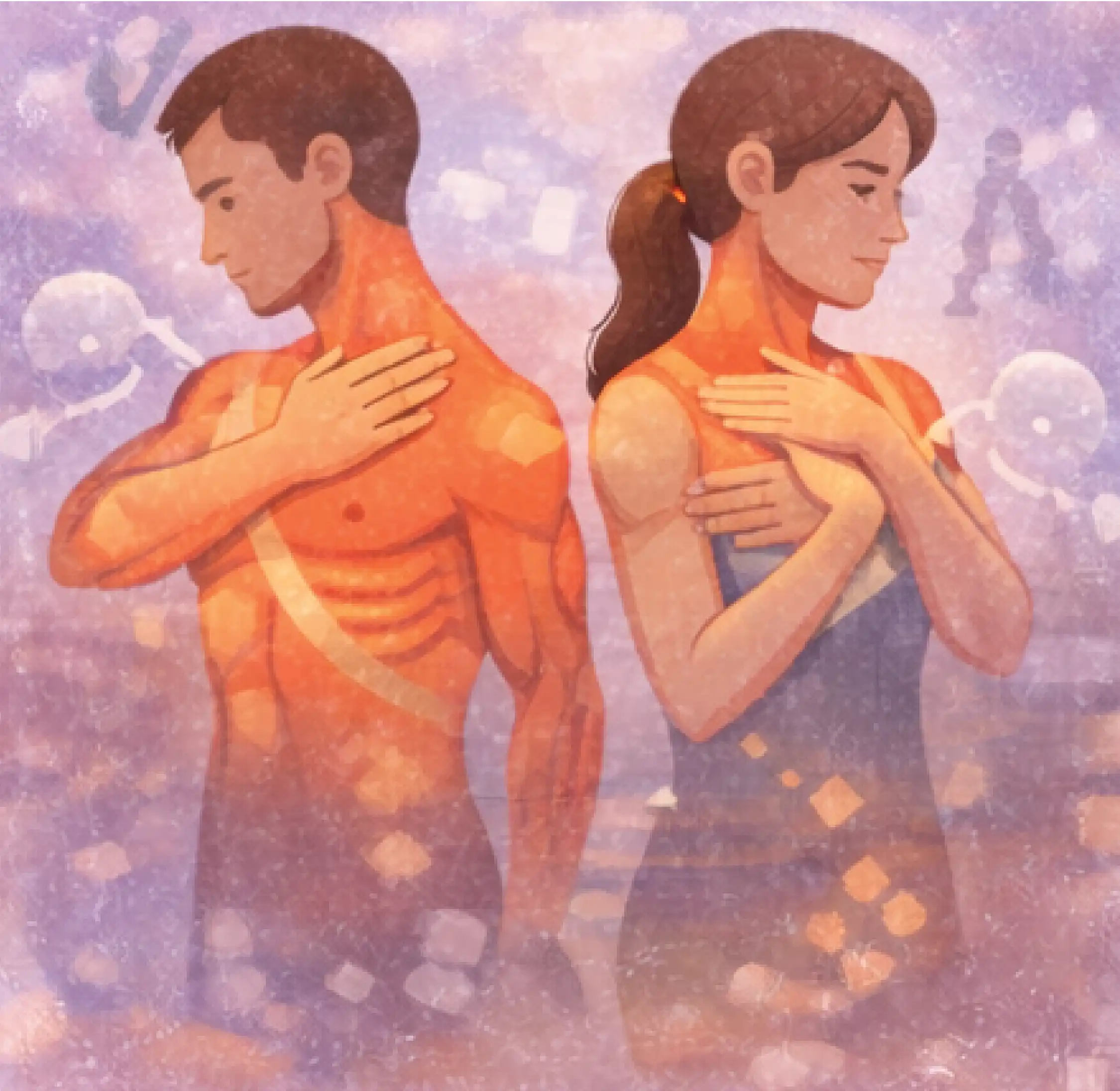

“Why does my body remember what my mind forgot?”
You’re fine—until you’re not. A certain tone, a slammed door, a fast-approaching deadline… and your jaw locks, shoulders climb to your ears, breath turns shallow, and your spine folds like you’re bracing for a wave. Later you think, I handled that okay—but why did my body act like I was in danger? Here’s the quiet truth: your body is a historian with a terrible filing system. It stores patterns, not paragraphs—tightness here, breath there, a posture that once kept you safe. The event may be over; the pattern remains. That’s what people mean when they say “trauma lives in the body.” Not ghosts or mysticism—neurobiology, habit loops, and protective reflexes that never got the memo that life has changed. This article is your field guide to the trauma body: how stress gets encoded in muscles, breath, and posture; how to read the “somatic script” your nervous system is acting out; and how therapy helps you rewrite it—gently, measurably, and without reliving everything.What “Stored in the Body” Actually Means (No woo, just wiring)
Your nervous system has three big jobs: detect threat, mobilize you to respond, and stand down when it’s safe. When a stressor lands—accident, betrayal, chronic criticism, sudden loss—your brain fires a survival sequence:- Sympathetic activation (fight/flight): heart up, breath shallow and high, muscles primed (neck, jaw, shoulders, hip flexors).
- Parasympathetic override (freeze/shutdown) when overwhelm exceeds coping: breath flattens, posture collapses, energy drains, mind “checks out.”
Three Body Systems That Carry Yesterday Into Today
1) Breath (your fastest state dial)
Stress shifts breathing up and fast—into the chest and shoulders. Over time, this becomes your default even at rest. Results: constant “near-anxious” buzz, poor CO₂ tolerance (dizziness, tingles), voice that thins under pressure, and sleep that never quite restores. Clues: you sigh a lot, can’t find deep belly breath, yawn when stressed, speak in short bursts.2) Muscle tone & fascia (your silent armor)
The startle reflex tightens SCM and trapezius (neck/shoulders), masseter (jaw), pectorals (hunched chest), and the psoas (hip flexor nicknamed the “fight/flight” muscle). Fascia—the connective web around muscles—densifies along these lines, reinforcing the shape. Chronic bracing = headaches, TMJ, back ache, hip pain that PT can only partly fix. Clues: teeth grinding; rounded, guarded shoulders; tenderness along the collarbone; hips that feel “stuck.”3) Posture & movement (the long story in one photo)
Posture is a prediction about the world. Forward fold says “anticipate impact.” Chin up + rib flare says “I’m fine, stay back.” Minimal arm swing, rigid gait, or fidgety micro-movements are all safety strategies. None are “bad.” They’re context-mismatched. Clues: you stand to the side in groups, sit at the edge of chairs, avoid eye contact under stress, or hold your breath before speaking.How the Brain Makes the Body Do This (and keep doing it)
- The amygdala (threat detector) links cues (voice tone, smell, time of day) with danger.
- The insula tracks inside-sensation (tight chest, flutter stomach) and tags it as meaningful.
- The prefrontal cortex should recalibrate with facts—I’m safe now—but when stress is high, it gets outvoted.
- The basal ganglia automate the motor plan: clench, hunch, hold.
Micro-Catalogue: Common Somatic Patterns of Unfinished Stress
- The Elevator Ribcage: chest lifted, breath stuck high → often perfectionism + perform-ready vigilance.
- The Turtled Shoulders: scapulae forward, neck tight → social threat sensitivity; “don’t notice me.”
- Iron Jaw, Soft Words: masseter clenched while voice stays polite → anger suppressed, boundaries costly.
- The Psoas Perch: sitting on the front edge, knees ready → flight primed, can’t relax into chairs.
- Freeze Frame: slack posture, slow blink, flat tone → system choosing shutdown over conflict.
Why Talk Alone Isn’t Enough (and why you still need it)
Talk reorganises meaning; the body wants experiences. You can understand your childhood perfectly and still flinch when a cupboard slams. That flinch changes when the nervous system experiences a different outcome under a familiar cue. Good therapy integrates both: top-down (cognition, story, choice) and bottom-up (breath, movement, sensation, posture) so the new story has a physiological home.A Practical Self-Assessment (5 minutes, zero judgment)
Grab your phone camera (or a mirror).- Breath Check (60 seconds): Put one hand on chest, one on belly. Where does the first ⅔ of the inhale go? If it starts high every time, your alarm likes the driver’s seat.
- Jaw & Tongue (30 seconds): Lightly tap molars; notice baseline clench. Rest tongue on the palate, wide and soft. If that feels foreign, you’re making space your body hasn’t allowed.
- Shoulder Scan (30 seconds): Inhale; shrug to ears; exhale; let drop. Do they actually drop? If they hover, they’re “on duty.”
- Psoas Hint (30 seconds): Lie on your back, knees bent. Place hands on hip bones. On exhale, let knees knock together. If your low back sighs in relief, your hip flexors needed permission.
- Posture Snapshot: Take a side photo. Is head forward of shoulders? Ribs flaring? Pelvis tucked under? All are strategies. Note them, don’t judge.
Regulation Before Repatterning (the order matters)
You cannot coach a locked-up body with pep talks. You need state downshifts first.1) Exhale-Weighted Breathing (2 minutes)
Inhale through nose for 4, exhale for 6–8. Don’t force; lengthen gently. Longer exhales nudge the vagal brake, signalling “we can stand down.”2) Physiological Sigh (30–60 seconds)
Two quick inhales through the nose (second a sip), long mouth exhale with a soft fff. Three to five reps unclench the chest and resets CO₂.3) Orienting (60–90 seconds)
Turn your head slowly left-right, eyes tracking edges of the room. Name five colors you can see. This tells the amygdala: no predator here. Do one before difficult emails, calls, or social moments. You’re creating safer reps.Repatterning the Trauma Body: Gentle, Specific Drills
Important: If you have a trauma history with dissociation or panic, go slow. Stop if you feel dizzy/far away. Working with a trauma-informed therapist can make these safer and more effective.A) Jaw–Diaphragm Pairing (3 minutes)
- Place fingertips lightly on jaw hinges.
- Inhale nose; on exhale, let the jaw un-hinge—lips parted, tongue wide.
- Add a soft “vvv” or “mmm” hum on the exhale; feel vibration in the chest. Why it works: relaxing jaw lets the diaphragm descend; hums stimulate vagal pathways.
B) Shoulder “Melt & Glide” (2 minutes)
- On exhale, imagine your collarbones sliding wide.
- Keep elbows heavy; sweep arms from pockets to half-T.
- Stop before stretch pain; aim for glide, not pull. Why it works: invites the startle muscles to yield without forcing.
C) Psoas Unclench (5 minutes)
- Lie on back near a wall. Feet up, knees at 90°.
- Inhale—pelvis stays heavy. Exhale—imagine your thighs “dropping” into the hip sockets.
- Optional: place a light weight (book) on the lower belly for feedback. Why it works: gives the hip flexors a supported rest, retraining “ready to run” into “allowed to rest.”
D) Spine Permission (2 minutes)
- Sit tall. Tiny forward/backward rocks of the pelvis.
- Let the chest follow (micro flex/extend).
- Keep the throat soft; breathe. Why it works: restores micro-mobility to a braced column; safety through small motion.
E) Stand-to-Speak Reset (30 seconds)
Before a tough conversation:- Exhale fully.
- Drop shoulders; press toes lightly into the floor.
- Let sternum float up one millimeter (not a proud lift).
- Speak on the next exhale. Why it works: grounds you (toes), de-braces the chest, and prevents breath-thief sentences.
How Counselling Works With the Body (so changes stick)
A trauma-informed counsellor will typically:- Map your triggers and somatic signatures. (Jaw for criticism, chest for uncertainty, gut for conflict.)
- Install regulation first. You’ll practice the breath/orient/ground set in session until your body trusts it.
- Titrate exposure. We’ll revisit difficult themes in tiny bites while you stay physically regulated. Your brain learns this cue can coexist with calm.
- Rework the story. Cognitive and narrative tools reframe beliefs (“I’m not safe” → “I can create safety”). The body changes hold the new story.
- Measure outcomes. Short scales for anxiety, sleep, pain, and “time to recover” make progress visible. (Less drama, faster return to baseline.)
A 7-Day Gentle Reset (bookmark this)
Day 1 — Notice Without Fixing (5 min) Do the self-assessment. Write three neutral observations: “Breath high,” “Right shoulder higher,” “Jaw tight on emails.” Day 2 — Exhale Practice (2 × 2 min) Morning & evening: 4-in, 6–8-out. After each round, whisper: “Safe enough right now.” Day 3 — Jaw–Diaphragm Pair (3 min) Add the hums. Keep it comfortable. Note if sleep or voice changes. Day 4 — Shoulder Glide + Orient (3 min) Glide arms, then slow head turns. Spot five colors. Check shoulder drop. Day 5 — Psoas Unclench (5 min) Wall 90°. Afterward, stand and notice your stride. No judging—just data. Day 6 — Real-Life Rehearsal (2 min before a mild stress) Pick a small trigger (inbox, call). Do exhale + orient; then act. Log how the action felt vs. usual. Day 7 — Evidence List (5 min) Write five micro-shifts (even 5%): “I paused before replying,” “Walk felt looser,” “Headache came later.” Brains rewire through exceptions. Repeat the week. Add one new drill if—and only if—you’re not getting dizzy or numb.When “Body Work” Isn’t Safe to DIY (red flags)
- Frequent dissociation (time loss, feeling unreal).
- Flashbacks or intrusive images.
- Explosive anger you can’t predict.
- Self-harm urges, active substance relapse, eating disorder flare.
- Pain that worsens sharply or neurologic symptoms (numbness/weakness).
FAQs (that your body’s been asking)
“If I relax, won’t I fall apart?” No. You’re not removing all tone; you’re switching from emergency bracing to functional support. Think alert but unarmed. “Do I have to relive everything?” No. Effective trauma therapy focuses on present safety and capacity, then processes the past in tolerable doses, often without graphic detail. “I tried deep breathing and got anxious.” Common. Start with exhale-only work and orienting. Some bodies read big belly breaths as vulnerable at first. “Can exercise replace all this?” Movement helps, but if you sprint from the same braced pattern, you may reinforce it. Pair activity with awareness + breath.What “Better” Looks Like (it’s shockingly ordinary)
- You notice the shoulder creep and it drops.
- Breath returns mid-argument instead of three hours later.
- Headaches visit less, leave earlier.
- You sit back in a chair without scanning exits.
- You speak one sentence slower and hear the difference.
- Sleep deepens. You wake with some calm in the bank.
The Mr. Psyc Way (bringing body + mind under one roof)
- Screening & mapping of stress patterns (so we don’t guess).
- Breath/orient/ground training you can do in 2–5 minutes anywhere.
- Somatic-informed counselling to pair new body states with new stories.
- Outcome tracking (pain hours, recovery time, sleep, mood) so progress is visible.
- Referral pathways (physio/psychiatry) when medication or targeted bodywork is appropriate.